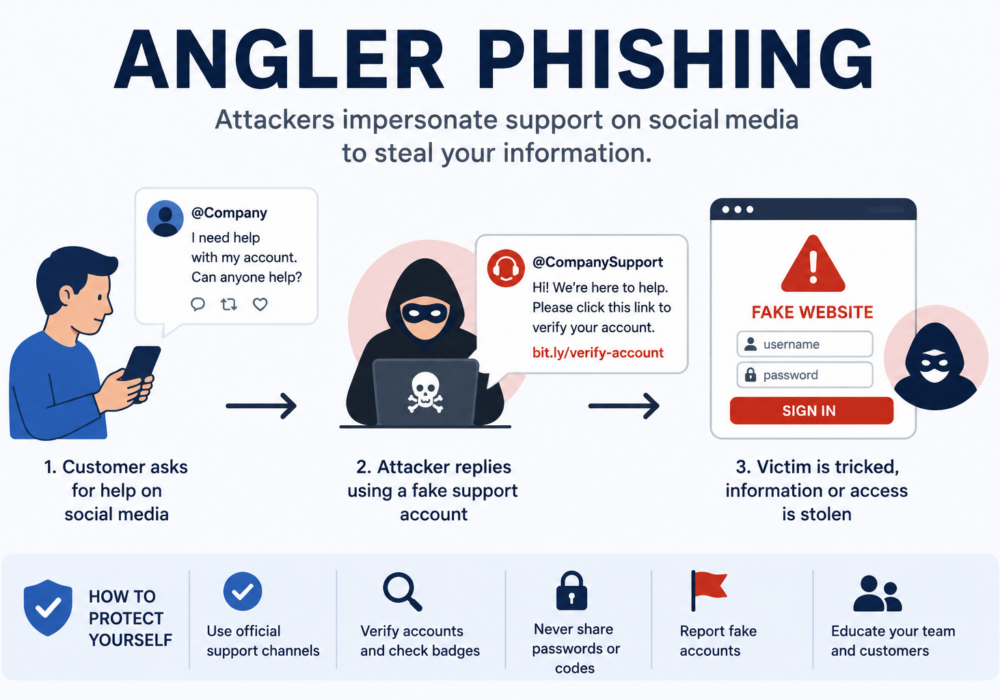
Angler phishing is a form of social engineering in which cybercriminals impersonate a company’s customer support team on social media to trick people into revealing sensitive information, downloading malware, or making fraudulent payments.
Rather than sending phishing emails, attackers monitor platforms such as X (formerly Twitter), Facebook, Instagram, and LinkedIn for users asking companies for help. They then quickly respond using fake accounts that closely resemble the company’s official support profile.
Because the victim believes they are communicating with legitimate customer service, angler phishing can be highly effective.
A typical angler phishing attack follows these steps:
These fake accounts often appear convincing, making it difficult for users to distinguish them from legitimate support channels.
Attackers use angler phishing to:
Small and midsize businesses increasingly rely on social media to engage with customers. If attackers impersonate the business, customers may unknowingly share sensitive information or lose money, damaging the company’s reputation.
Potential consequences include:
SMBs often have fewer resources to monitor social media continuously, making them attractive targets.
Managed Service Providers (MSPs) frequently provide support through email, chat, and social media. Attackers can impersonate MSP technicians or support accounts to target customers.
Risks include:
Because MSPs are trusted advisors, attackers often exploit that trust to deceive customers.
Organizations can reduce their risk by:
| Angler Phishing | Traditional Phishing |
|---|---|
| Takes place on social media | Usually delivered by email or text |
| Impersonates customer support | Impersonates banks, companies, or coworkers |
| Targets people seeking assistance | Targets anyone who receives the message |
| Often begins with public posts | Usually begins with unsolicited messages |
Angler phishing is a social media-based phishing attack that exploits trust in customer support by impersonating legitimate company accounts. For SMBs, it can damage customer relationships, lead to fraud, and harm brand reputation. For MSPs, it poses an even greater risk because attackers may impersonate trusted technicians to gain access to customer systems. Monitoring social media, educating users, and securing official accounts are essential defenses against angler phishing.ials and sensitive information before attackers can use them. For SMBs, it offers an early warning system against account compromise and ransomware. For MSPs, it enables proactive customer protection, strengthens managed security offerings, and demonstrates ongoing cybersecurity value by identifying threats before they become incidents.
Additional Reading:
CyberHoot does have some other resources available for your use. Below are links to all of our resources, feel free to check them out whenever you like:
Discover and share the latest cybersecurity trends, tips and best practices – alongside new threats to watch out for.
Author: Katie Boquetti | Editorial: Craig Taylor Editorial by Craig Taylor: We've known for a while here...
Read more
Author: Katie Boquetti | Editorial: Craig Taylor Editorial by Craig Taylor: A CAPTCHA should test whether...
Read more
Author: Katie Boquetti | Editorial: Craig Taylor Editorial by Craig Taylor: I'm blessed to have...
Read moreGet sharper eyes on human risks, with the positive approach that beats traditional phish testing.