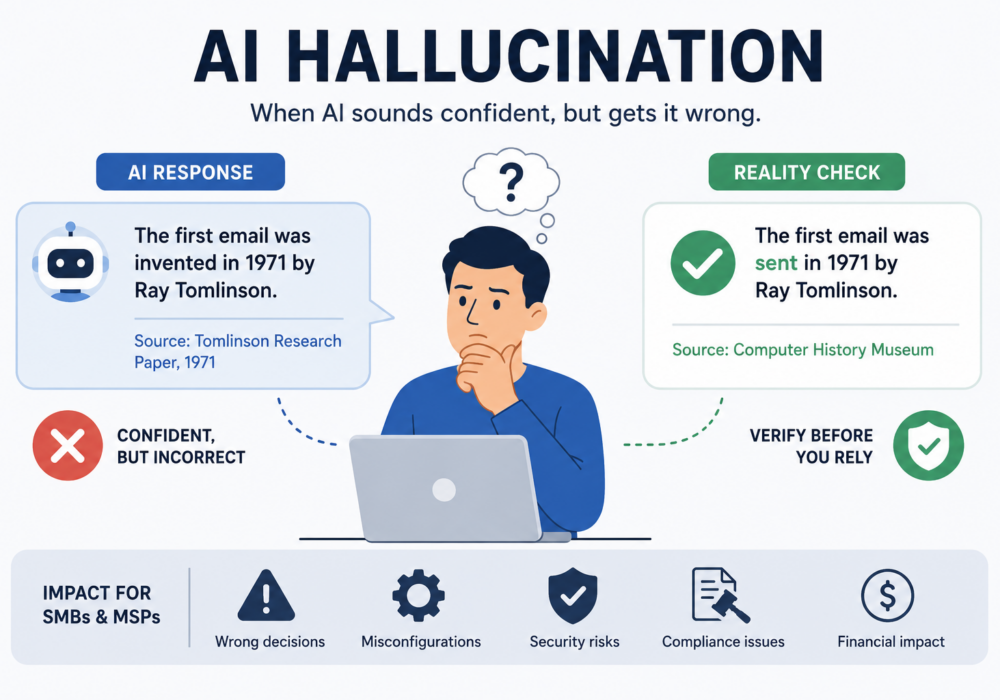
An AI hallucination occurs when an artificial intelligence system generates information that sounds accurate and convincing but is actually false, misleading, or entirely fabricated. Unlike a human making an intentional guess, the AI does not “know” the information is incorrect—it simply predicts the most likely response based on patterns in its training data.
AI hallucinations can include fabricated facts, fake citations, incorrect calculations, nonexistent legal cases, imaginary software features, or inaccurate cybersecurity guidance.
AI hallucinations can occur for several reasons:
Because the responses often appear fluent and confident, hallucinations can be difficult to recognize without verification.
Examples include:
In cybersecurity, acting on hallucinated information can introduce new risks instead of solving existing ones.
Many small and midsize businesses are rapidly adopting AI tools to improve productivity. While AI can accelerate everyday tasks, relying on inaccurate outputs without verification can lead to costly mistakes.
Potential impacts include:
SMBs should treat AI as a productivity tool—not an unquestionable source of truth.
Managed Service Providers (MSPs) increasingly use AI to assist with troubleshooting, scripting, documentation, customer support, and security operations. An unverified hallucination can affect multiple customers if used in production.
Risks include:
Because MSPs manage many client environments, validating AI-generated content is essential before deployment.
Organizations can minimize risk by:
AI should augment human expertise—not replace it.
Although related, these concepts are different:
| AI Hallucination | AI Bias |
|---|---|
| Produces false or fabricated information | Produces systematically unfair or skewed results |
| Caused by prediction errors or missing information | Caused by biased training data or model behavior |
| Can affect any topic | Often affects people, groups, or decisions |
| Primarily an accuracy problem | Primarily a fairness problem |
AI hallucinations are incorrect or fabricated responses generated by artificial intelligence that appear believable but are not based on factual information. For SMBs, they can lead to poor business and cybersecurity decisions if accepted without verification. For MSPs, the risks are even greater because inaccurate AI-generated guidance, scripts, or configurations can affect multiple customer environments. The best practice is to use AI as a powerful assistant while validating important outputs before acting on them.
Additional Reading:
CyberHoot does have some other resources available for your use. Below are links to all of our resources, feel free to check them out whenever you like:
Discover and share the latest cybersecurity trends, tips and best practices – alongside new threats to watch out for.

Author: Katie Boquetti | Editorial: Craig Taylor Editorial by Craig Taylor: We've known for a while here...
Read more
Author: Katie Boquetti | Editorial: Craig Taylor Editorial by Craig Taylor: A CAPTCHA should test whether...
Read more
Author: Katie Boquetti | Editorial: Craig Taylor Editorial by Craig Taylor: I'm blessed to have...
Read moreGet sharper eyes on human risks, with the positive approach that beats traditional phish testing.