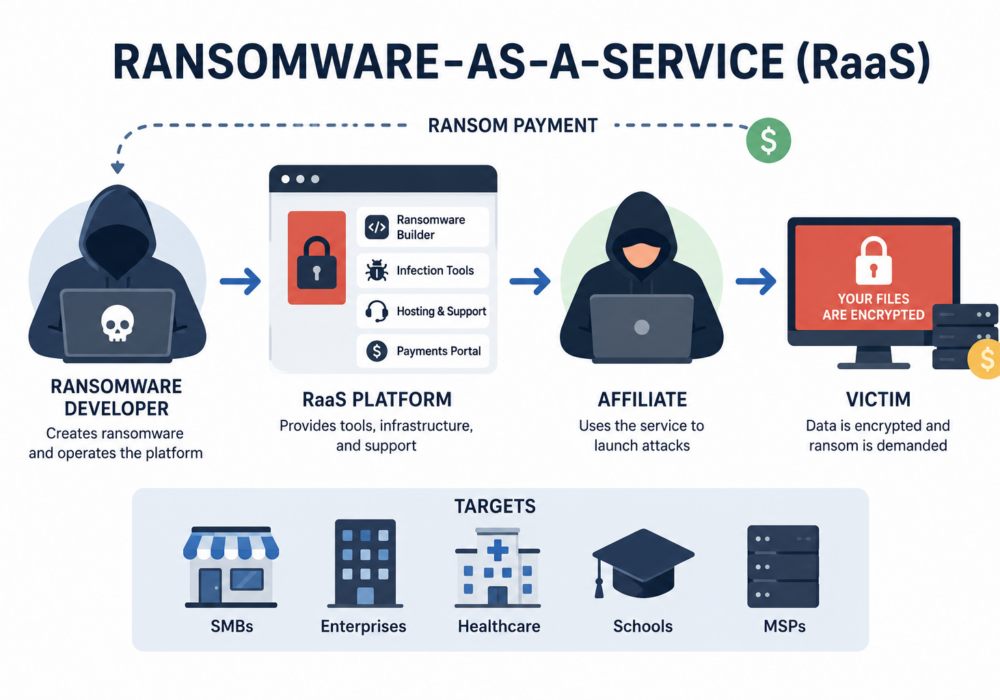
Ransomware-as-a-Service (RaaS) is a cybercrime business model in which experienced ransomware developers create and maintain ransomware software, then lease or sell it to other criminals—known as affiliates—who carry out the attacks. In exchange, the developers receive a percentage of each ransom payment.
Much like legitimate Software-as-a-Service (SaaS), RaaS platforms provide the tools, infrastructure, updates, and support needed to launch attacks. This has dramatically lowered the barrier to entry for cybercriminals, allowing individuals with little technical expertise to conduct sophisticated ransomware campaigns.
A typical RaaS operation follows these steps:
Many RaaS groups provide dashboards, technical support, negotiation services, and payment portals—operating much like legitimate software companies.
Small and midsize businesses are frequent targets because they often have limited cybersecurity resources but still rely heavily on their data and systems to operate.
A successful RaaS attack can result in:
Many modern ransomware attacks use double extortion, where attackers both encrypt files and threaten to publish stolen data if the ransom is not paid.
Managed Service Providers (MSPs) are particularly attractive targets because compromising one MSP can provide access to many customer networks.
A successful RaaS attack against an MSP can:
Because MSPs often have privileged administrative access, attackers view them as high-value targets for large-scale ransomware campaigns.
Organizations can significantly reduce their risk by:
RaaS has transformed ransomware into a scalable criminal industry. By separating malware development from attack execution, it enables more criminals to launch sophisticated attacks with minimal technical expertise. As a result, ransomware has become one of the most common and costly cyber threats facing organizations today.
Ransomware-as-a-Service is a subscription-based cybercrime model that enables criminals to launch ransomware attacks using professionally developed malware. For SMBs, it increases the likelihood of becoming a target due to the growing number of attackers. For MSPs, the stakes are even higher, as a single compromise can impact many customers. Strong authentication, secure backups, employee training, and layered security remain the best defenses against RaaS attacks.
Additional Reading:
CyberHoot does have some other resources available for your use. Below are links to all of our resources, feel free to check them out whenever you like:
Discover and share the latest cybersecurity trends, tips and best practices – alongside new threats to watch out for.
Author: Katie Boquetti | Editorial: Craig Taylor Editorial by Craig Taylor: I'm blessed to have...
Read more
Author: Katie Boquetti | Editorial: Craig Taylor Editorial by Craig Taylor: I remember the early days of...
Read more
Author: Katie Boquetti | Editorial: Craig Taylor Editorial by Craig Taylor: This week's blog has a...
Read moreGet sharper eyes on human risks, with the positive approach that beats traditional phish testing.