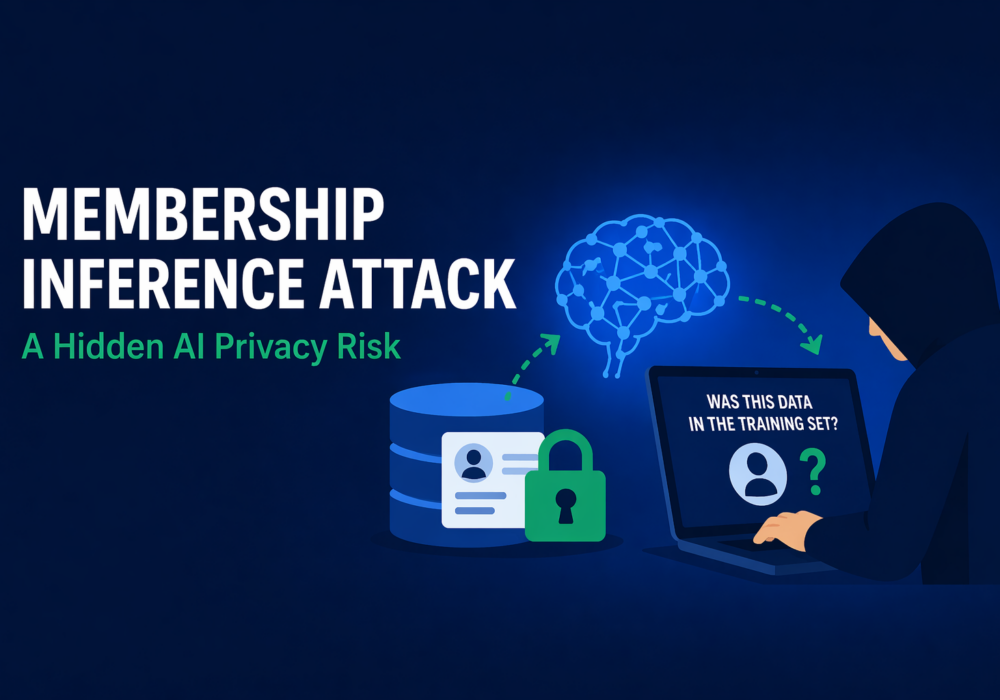
A membership inference attack is a machine learning privacy attack in which an attacker tries to determine whether a specific person’s data, record, or example was included in the training dataset of an AI or ML model. NIST defines it as a data privacy attack used to determine whether a data sample was part of a model’s training set. OWASP also treats it as a machine learning security risk because a model can sometimes reveal clues about the data it was trained on.
This matters because even if the attacker cannot see the original training data directly, learning that a person’s record was included can still expose sensitive information. For example, it could reveal that someone was part of a medical, financial, legal, or internal business dataset. NIST’s AI risk guidance highlights membership inference as one of the security and privacy risks organizations should account for in AI systems.
For small and medium sized businesses, a membership inference attack is a warning that using AI tools or custom machine learning models can create privacy risk if customer, employee, or business sensitive data is used for training. Even if the model seems harmless on the surface, it may leak signals about who or what was in the training data.
In practical terms, SMBs should understand that:
For Managed Service Providers, membership inference attacks matter both internally and across client environments. If an MSP builds, deploys, manages, or recommends AI systems that were trained on sensitive client data, there is a risk that attackers could test whether specific records were included in that training set. Because MSPs often handle many clients, poor AI data handling practices could create privacy exposure across multiple organizations.
In practice, MSPs should:
A membership inference attack is an attempt to find out whether specific data was used to train an AI model. For SMBs, that means private business, employee, or customer data could be exposed indirectly. For MSPs, it means AI services must be handled carefully so client data is not put at unnecessary privacy risk.
Additional Reading:
CyberHoot does have some other resources available for your use. Below are links to all of our resources, feel free to check them out whenever you like:
Discover and share the latest cybersecurity trends, tips and best practices – alongside new threats to watch out for.

Author: Katie Boquetti | Editorial: Craig Taylor Editorial by Craig Taylor: We've known for a while here...
Read more
Author: Katie Boquetti | Editorial: Craig Taylor Editorial by Craig Taylor: A CAPTCHA should test whether...
Read more
Author: Katie Boquetti | Editorial: Craig Taylor Editorial by Craig Taylor: I'm blessed to have...
Read moreGet sharper eyes on human risks, with the positive approach that beats traditional phish testing.