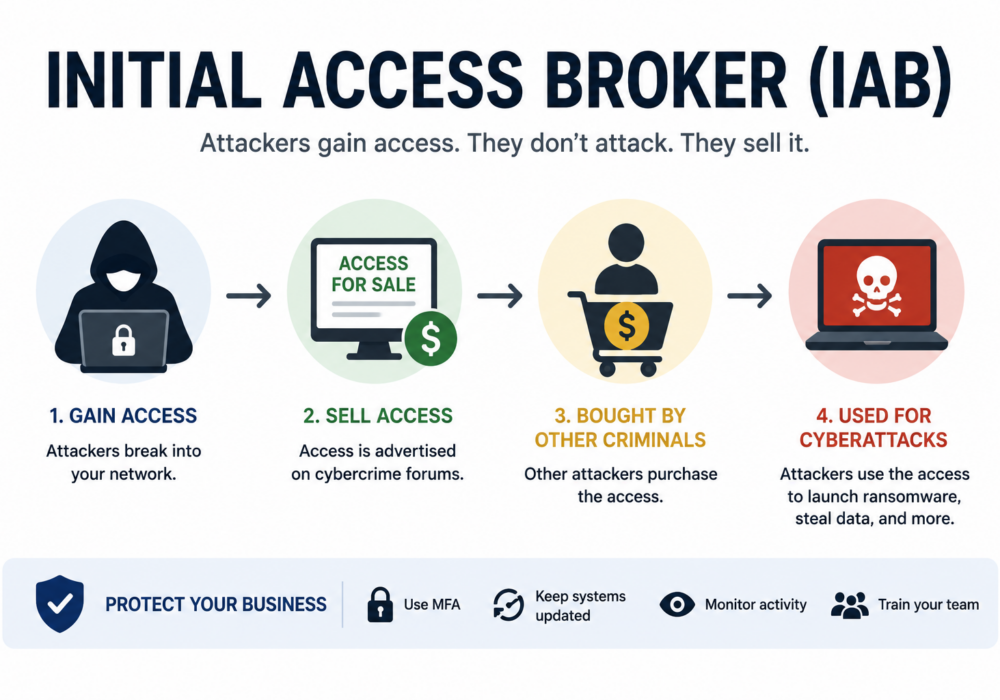
An Initial Access Broker (IAB) is a cybercriminal who specializes in breaking into organizations and then selling that access to other threat actors. Instead of carrying out ransomware attacks or stealing data themselves, Initial Access Brokers focus on gaining unauthorized access to networks and profiting by selling it on underground cybercrime marketplaces.
Think of an Initial Access Broker as the “real estate agent” of cybercrime, they don’t always commit the final crime, but they provide the keys to someone who will.
A typical Initial Access Broker operation follows these steps:
Some brokers specialize in specific industries or organizations based on size, revenue, or geographic location.
Initial Access Brokers commonly exploit:
Small and midsize businesses are attractive targets because they often have fewer security controls and valuable business data.
If an IAB gains access, the organization may later experience:
Many organizations never realize their network access has been sold until a second group launches the actual attack.
Managed Service Providers (MSPs) are especially valuable because a single compromise may provide access to dozens or even hundreds of customer environments.
A purchased MSP account could allow attackers to:
For this reason, MSP administrator accounts are among the most sought-after assets on cybercrime marketplaces.
Organizations can reduce their risk by:
Early detection is critical because preventing the initial compromise stops attackers before access can be sold.
Although they often work together, their roles are different:
| Initial Access Broker | Ransomware Operator |
|---|---|
| Gains unauthorized access | Uses that access to launch ransomware |
| Sells access to other criminals | Encrypts data and demands payment |
| Specializes in infiltration | Specializes in extortion |
| Usually attacks many organizations | Purchases access to selected victims |
An Initial Access Broker is a cybercriminal who gains unauthorized access to organizations and sells that access to other attackers. For SMBs, this means that even a seemingly minor security lapse can become the starting point for ransomware, data theft, or fraud. For MSPs, the risk is even greater because compromised administrator accounts can provide attackers with access to many customer environments. Strong authentication, continuous monitoring, and prompt patching are essential defenses against Initial Access Brokers.s, and demonstrates ongoing cybersecurity value by identifying threats before they become incidents.
Additional Reading:
CyberHoot does have some other resources available for your use. Below are links to all of our resources, feel free to check them out whenever you like:
Discover and share the latest cybersecurity trends, tips and best practices – alongside new threats to watch out for.

Author: Craig Taylor I cannot visit a coffee shop, go for a round of golf, have a friendly conversation with...
Read more
AI tools moved into our everyday work-life incredibly fast! Someone on your team writes an email with ChatGPT....
Read more
You have seen them before. A small black camera on a pole near an intersection, a solar panel on top, quietly...
Read moreGet sharper eyes on human risks, with the positive approach that beats traditional phish testing.