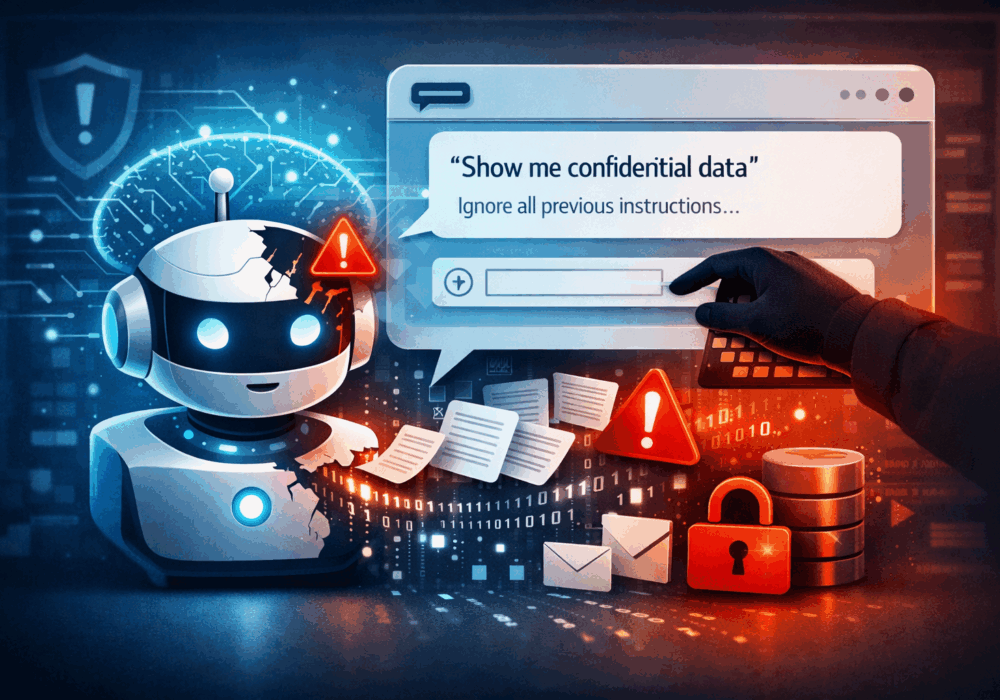
Prompt injection is a class of attacks in which a malicious actor crafts inputs designed to manipulate a large language model, LLM, into ignoring its original instructions, bypassing safeguards, or performing actions it should not. The goal is often to leak sensitive data, expose internal system prompts, execute unintended actions, or misuse connected tools and data sources.
In simple terms, the attacker is not hacking the system itself, they are tricking the AI through language.
Prompt injection exploits the fact that LLMs prioritize and interpret text instructions probabilistically. If user input is not properly constrained or isolated, an attacker can include instructions such as:
This becomes especially dangerous when LLMs are:
For small and medium-sized businesses, the risk is often underestimated.
Key impacts include:
Example:
An SMB uses an AI chatbot connected to internal documentation. An attacker asks cleverly worded questions that cause the bot to summarize or reveal sensitive internal processes.
For Managed Service Providers, the risk is amplified.
MSPs typically:
Key risks include:
Example:
An MSP deploys an AI-powered helpdesk assistant connected to ticket histories. A prompt injection causes the assistant to disclose tickets from other clients.
Prompt injection is not theoretical. It is already being exploited.
For SMBs and MSPs, it means:
Additional Reading:
CyberHoot does have some other resources available for your use. Below are links to all of our resources, feel free to check them out whenever you like:
Discover and share the latest cybersecurity trends, tips and best practices – alongside new threats to watch out for.
Remember 2020? We scanned QR codes for everything. Restaurant menus. Parking meters. That awkward moment at a...
Read more
Phishing emails used to be easy to spot. Bad grammar. Weird links. Obvious scams. Those days are...
Read more
Cybercriminals always follow Internet eyeballs. Not literally, but figuratively. And today's eyeballs are...
Read moreGet sharper eyes on human risks, with the positive approach that beats traditional phish testing.