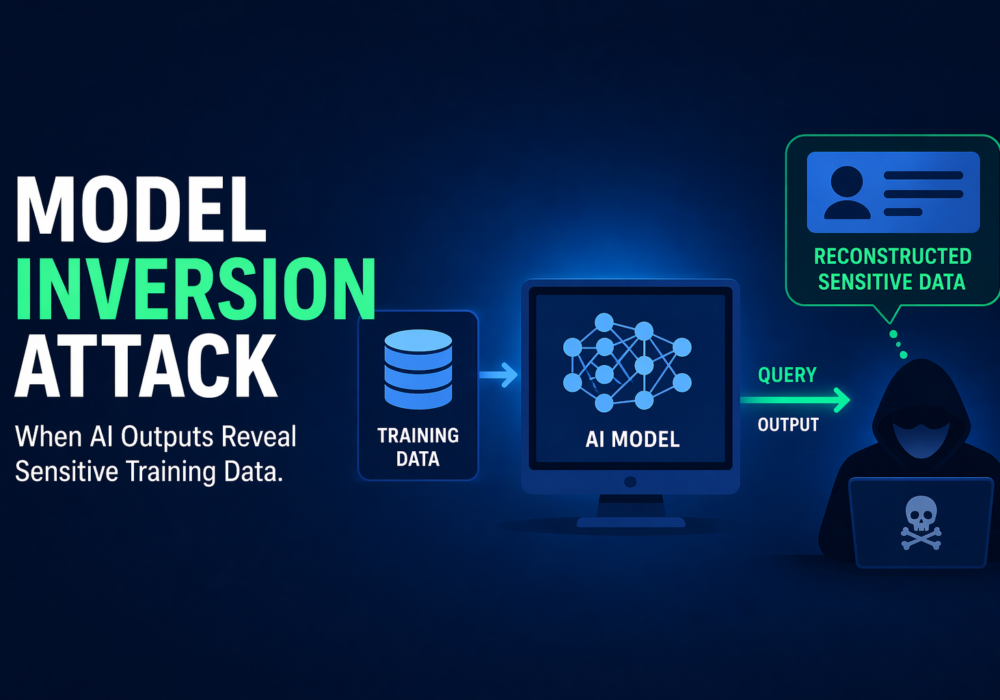
A model inversion attack is a machine learning privacy attack in which an attacker uses a model’s outputs to infer, reconstruct, or recover sensitive information about the data used to train it. Microsoft describes this as recovering private features used in machine learning models, including reconstructing private training data the attacker does not directly have access to. OWASP similarly describes it as reverse engineering a model to extract information from it.
In simpler terms, the attacker does not necessarily steal the original dataset directly. Instead, they query the model and analyze its responses until they can learn something sensitive about the people, records, or source data behind it. OWASP’s Secure AI Model Ops guidance notes that model inversion and extraction can allow attackers to reconstruct training data via inference queries, and NIST’s adversarial machine learning taxonomy identifies model inversion as a recognized privacy risk in ML systems.
For small and medium sized businesses, a model inversion attack means that an AI model trained on sensitive business, customer, or employee data could unintentionally reveal pieces of that data. This matters most when models are trained on private records such as customer profiles, HR data, financial information, medical information, or proprietary internal data. Microsoft’s threat modeling guidance specifically lists model inversion as an AI attack surface, and IBM’s AI privacy guidance also discusses inversion attacks as a way sensitive information can be exposed through ML systems.
In practical terms, SMBs should understand that:
For Managed Service Providers, model inversion attacks matter both for their own AI use and for any AI systems they deploy, manage, or recommend for clients. Because MSPs often work across multiple customer environments, one weak AI implementation could expose sensitive information from one or many clients. OWASP recommends controls such as limiting access to models and predictions, while Microsoft’s AI threat modeling guidance highlights the risk of recovering private features from deployed models.
In practice, MSPs should:
A model inversion attack is an attempt to learn sensitive training data by probing an AI or machine learning model. For SMBs, that means private business, customer, or employee information could leak indirectly through a model. For MSPs, it means AI systems must be designed, reviewed, and managed carefully so client data is not exposed through the models they use or support.nd careful handling of client data.
Additional Reading:
CyberHoot does have some other resources available for your use. Below are links to all of our resources, feel free to check them out whenever you like:
Discover and share the latest cybersecurity trends, tips and best practices – alongside new threats to watch out for.

Author: Katie Boquetti | Editorial: Craig Taylor Editorial by Craig Taylor: We've known for a while here...
Read more
Author: Katie Boquetti | Editorial: Craig Taylor Editorial by Craig Taylor: A CAPTCHA should test whether...
Read more
Author: Katie Boquetti | Editorial: Craig Taylor Editorial by Craig Taylor: I'm blessed to have...
Read moreGet sharper eyes on human risks, with the positive approach that beats traditional phish testing.