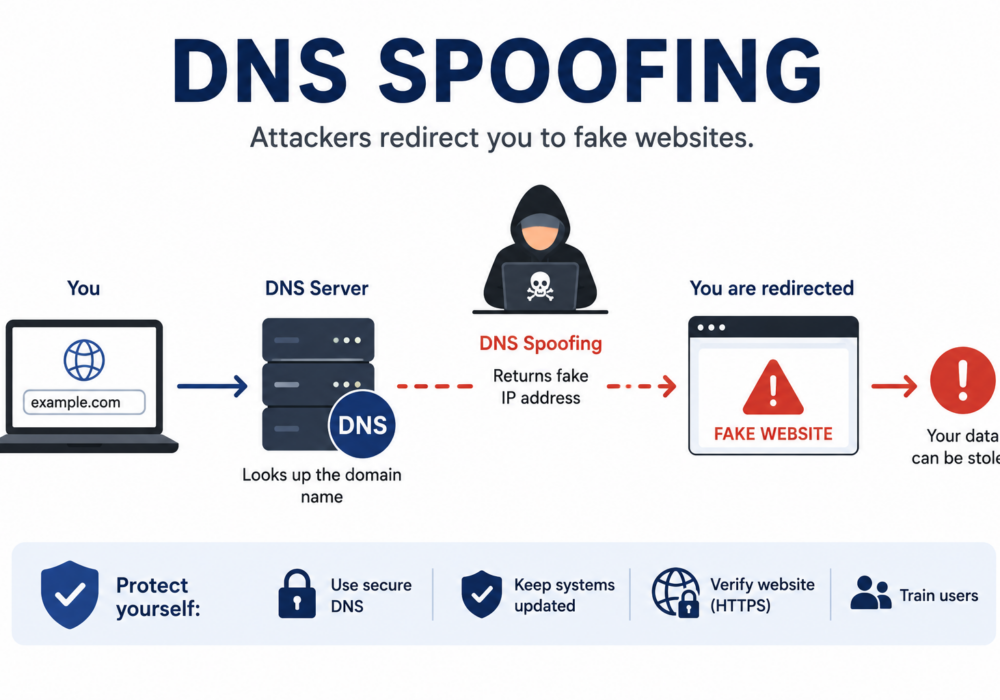
DNS Spoofing, also known as DNS Cache Poisoning, is a cyberattack in which an attacker manipulates the Domain Name System (DNS) to redirect users from a legitimate website to a malicious one. Because users often see the correct web address in their browser, they may unknowingly enter passwords, financial information, or other sensitive data into a fake website controlled by the attacker.
DNS acts as the Internet’s “phonebook,” translating domain names like example.com into IP addresses that computers use to locate websites. DNS spoofing corrupts this process by providing a false IP address for a legitimate domain.
A typical DNS spoofing attack follows these steps:
Because the fake website often looks identical to the real one, users may not realize they have been redirected.
Attackers use DNS spoofing to:
Small and midsize businesses depend on cloud services such as Microsoft 365, Google Workspace, online banking, and SaaS applications. If employees are redirected to fraudulent websites, attackers can steal business credentials and gain access to critical systems.
Potential consequences include:
Because many SMBs lack dedicated DNS security, attackers often view them as attractive targets.
Managed Service Providers (MSPs) oversee the networks and internet infrastructure of many customers. A successful DNS spoofing attack against an MSP or its managed DNS services can affect multiple client organizations simultaneously.
Risks include:
Protecting DNS infrastructure is a fundamental part of securing managed environments.
Organizations can reduce their risk by:
Although they often work together, they are different attacks:
| DNS Spoofing | Phishing |
|---|---|
| Redirects users by manipulating DNS records | Tricks users into clicking malicious links |
| Victims may type the correct website address | Victims are lured through deceptive emails or messages |
| Targets the internet’s naming system | Targets human behavior |
| Often invisible to the user | Relies on social engineering |
DNS spoofing is an attack that manipulates the internet’s address lookup system to redirect users to malicious websites without their knowledge. For SMBs, it can lead to stolen credentials, financial fraud, and malware infections. For MSPs, the impact can extend across multiple customer environments if DNS infrastructure is compromised. Using secure DNS services, enabling DNSSEC, implementing strong authentication, and educating users are key defenses against DNS spoofing attacks.
Additional Reading:
CyberHoot does have some other resources available for your use. Below are links to all of our resources, feel free to check them out whenever you like:
Discover and share the latest cybersecurity trends, tips and best practices – alongside new threats to watch out for.
Author: Katie Boquetti | Editorial: Craig Taylor Editorial by Craig Taylor: I'm blessed to have...
Read more
Author: Katie Boquetti | Editorial: Craig Taylor Editorial by Craig Taylor: I remember the early days of...
Read more
Author: Katie Boquetti | Editorial: Craig Taylor Editorial by Craig Taylor: This week's blog has a...
Read moreGet sharper eyes on human risks, with the positive approach that beats traditional phish testing.