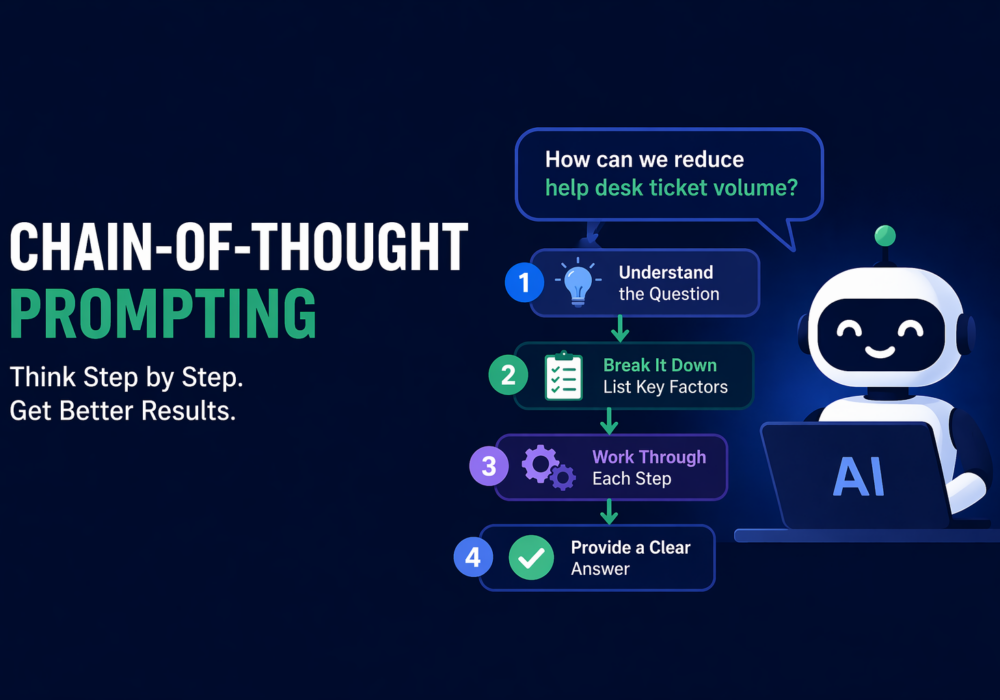
Chain of thought, or chain of thought prompting, is a prompt engineering technique where the user asks an AI model to work through a task step by step instead of jumping straight to the final answer. Microsoft describes it as prompting a model to perform a task step by step and present each step in order, and OpenAI describes prompt engineering more broadly as writing effective instructions so a model produces the result you want.
The goal of chain of thought prompting is usually to improve reasoning on more complex tasks, especially when a problem has multiple steps, rules, or calculations. It is commonly used for things like analysis, troubleshooting, structured decision making, and logic heavy questions. Anthropic also includes thinking related techniques as part of prompt engineering best practices.
At the same time, organizations should use it carefully. Some providers specifically warn that trying to extract hidden model reasoning is not always supported, especially for certain reasoning models, and may not be the right implementation approach. Microsoft’s current guidance notes that chain of thought prompting is applicable to non reasoning models, and that attempts to extract model reasoning through unsupported methods are not supported.
For small and medium sized businesses, chain of thought prompting is useful as a way to get more structured and explainable output from AI tools. It can help employees break down tasks such as drafting policies, summarizing incidents, analyzing risks, troubleshooting technical issues, or comparing options in a more organized way.
In practice, SMBs should understand that:
For Managed Service Providers, chain of thought prompting can help create better workflows for support, documentation, triage, and client communication. It can improve how AI assists with ticket analysis, root cause investigation, policy drafting, and operational checklists by encouraging more methodical output.
But MSPs also need to treat it as part of AI governance and security. If they rely too heavily on AI generated reasoning without validation, they can introduce mistakes into client environments. OWASP highlights prompt injection as a serious risk for LLM applications, which means any AI workflow based on prompts must be designed with guardrails and human review.
In practice, MSPs should:
Chain of thought prompting is a way of asking AI to work through a task step by step. For SMBs, it can improve clarity and usefulness in day to day business tasks. For MSPs, it can support better operational workflows, but it also requires validation, security controls, and careful handling of client data.
Additional Reading:
CyberHoot does have some other resources available for your use. Below are links to all of our resources, feel free to check them out whenever you like:
Discover and share the latest cybersecurity trends, tips and best practices – alongside new threats to watch out for.

Author: Katie Boquetti | Editorial: Craig Taylor Editorial by Craig Taylor: We've known for a while here...
Read more
Author: Katie Boquetti | Editorial: Craig Taylor Editorial by Craig Taylor: A CAPTCHA should test whether...
Read more
Author: Katie Boquetti | Editorial: Craig Taylor Editorial by Craig Taylor: I'm blessed to have...
Read moreGet sharper eyes on human risks, with the positive approach that beats traditional phish testing.