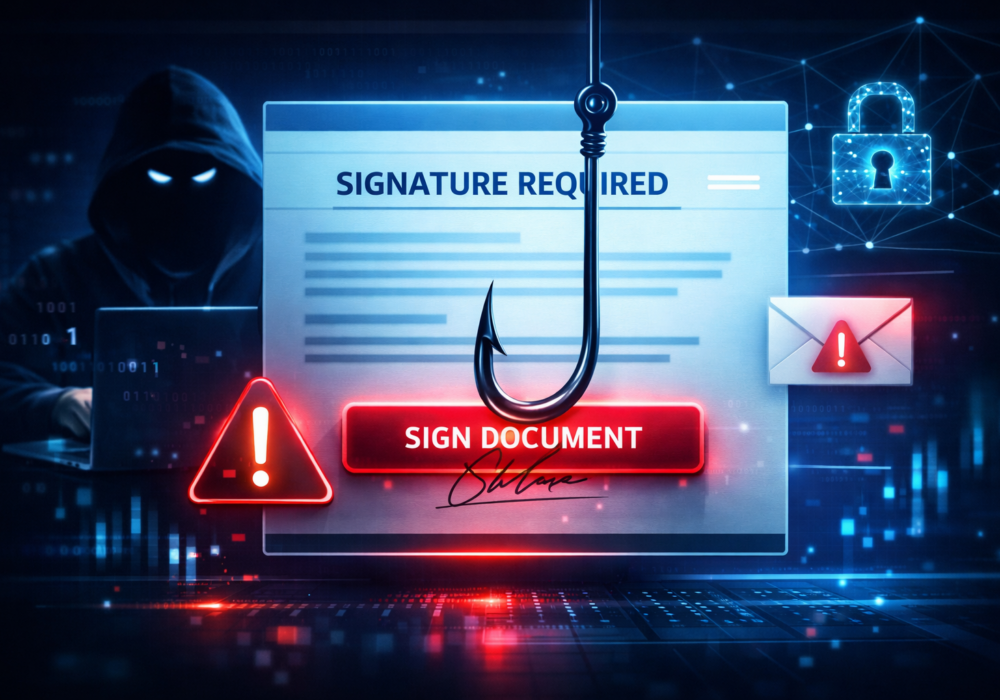
DocuSign has become one of the most trusted tools in modern business. Contracts, HR paperwork, NDAs, vendor agreements, and financial approvals move through it every day. When a DocuSign email arrives in your inbox, the natural reaction is simple: open it and sign.
Cybercriminals know this. And they are increasingly building phishing campaigns around that trust.
Security researchers have recently uncovered cybercrime forums where attackers openly sell customizable DocuSign phishing templates. These templates are designed to closely mimic legitimate DocuSign emails and documents, allowing criminals to launch convincing phishing campaigns with minimal effort.
The result is a surge in attacks targeting organizations that rely heavily on DocuSign.
Over the past year, security researchers have observed a noticeable increase in phishing emails impersonating DocuSign notifications. These messages are carefully crafted to resemble real document signing requests and often appear completely legitimate at first glance.
The success of these attacks is driven by three key factors. First, DocuSign is widely used across nearly every industry. Second, the platform has built strong trust among business users. And third, cybercriminal tactics have become far more sophisticated.
Instead of poorly written phishing emails, attackers now use professional templates that replicate the exact appearance of legitimate DocuSign messages.
When researchers traced one of these phishing campaigns back to its origin, they discovered an identical template being distributed on a Russian cybercrime forum.
This discovery revealed how organized these attacks have become.
Investigations into underground forums show that cybercriminals are actively buying and selling phishing templates designed specifically for DocuSign.
These templates closely resemble authentic DocuSign emails and document pages. Attackers can customize them with different company logos, messaging, and malicious links before sending them out as part of a phishing campaign.
In one forum thread, a seller offered DocuSign phishing templates and even provided custom modifications for a fee. The same seller also advertised templates impersonating companies like DHL and promised not to resell customized versions if buyers paid extra for exclusivity.
Further searches across multiple cybercrime communities revealed that large collections of phishing templates are widely available for purchase.
For attackers, this creates an easy entry point into phishing operations.
Launching a successful phishing campaign requires authenticity. The more legitimate the message looks, the more likely someone is to click.
Cybercriminals have two main options when creating these campaigns.
They can attempt to build phishing templates themselves, which requires technical skills and time. Or they can purchase ready-made templates from underground sellers.
Most attackers choose the second option.
Buying a template eliminates the design work and allows criminals to focus on distributing the phishing campaign. Many attackers also run multiple campaigns at once, targeting different platforms and services. Purchasing templates in bulk allows them to scale operations quickly and maximize profits.
In effect, phishing has become a marketplace.
When a victim enters their login information into a phishing page, those credentials are immediately captured and often sold on cybercrime forums.
Stolen DocuSign credentials can be purchased for as little as ten dollars.
Once attackers gain access to a company’s DocuSign account, they begin reviewing stored documents. Contracts, vendor agreements, payment schedules, and financial information provide valuable insight into how the organization operates.
This information allows attackers to launch business email compromise (BEC) scams.
In a typical BEC scheme, criminals impersonate the compromised company and send emails to business partners requesting payment transfers to fraudulent bank accounts. These requests often include fake contracts or payment instructions delivered through the hacked DocuSign account, making the request appear legitimate.
Because the payment request aligns with real business activity, victims may not realize anything is wrong until the money is gone.
A single successful BEC attack can divert hundreds of thousands of dollars.
Stolen DocuSign accounts can also expose sensitive corporate information, including financial records, client lists, and merger details. In some cases, attackers threaten to release this information publicly unless a ransom is paid.
Even sophisticated phishing campaigns still leave clues.
Start by examining the sender’s email address. Legitimate DocuSign emails originate from the docusign.net domain. Messages coming from other domains should be treated with caution.
Pay attention to how the email addresses you. Legitimate DocuSign notifications typically use your name, while phishing emails often rely on generic greetings.
DocuSign messages also contain a unique security code at the bottom of the email. These codes are long and complex. Short or simple codes may indicate a fraudulent message.
Always hover over links before clicking. Genuine DocuSign links should direct you to the official DocuSign domain. Links pointing to unrelated websites, Google Docs pages, or unexpected attachments are strong warning signs.
If you are unsure whether a message is legitimate, the safest option is to go directly to the DocuSign website and access documents there rather than clicking the link inside the email.
Organizations should assume that attackers will continue exploiting trusted platforms like DocuSign.
Security awareness training remains one of the most effective defenses. Employees should understand that trusted services can still be abused by cybercriminals.
Multi-factor authentication should be enabled wherever possible to reduce the impact of stolen credentials.
Organizations should also deploy advanced email security tools capable of analyzing behavior and context rather than relying solely on traditional spam filtering. These tools can identify anomalies that signal phishing or business email compromise attempts before they reach employees.
Just as importantly, companies should encourage employees to report suspicious messages immediately. Early detection can stop a phishing campaign before it spreads across the organization.
Cybercriminals no longer need to build phishing campaigns from scratch. They can simply purchase ready-made templates designed to mimic trusted services like DocuSign.
This growing underground marketplace has made phishing attacks easier to launch and harder to detect.
The best defense is awareness.
DocuSign itself remains a secure and trusted platform, but like any widely used service, it can be abused by attackers. When unexpected document requests arrive, taking a moment to verify them can prevent a costly mistake.
Discover and share the latest cybersecurity trends, tips and best practices – alongside new threats to watch out for.
Author: Katie Boquetti | Editorial: Craig Taylor Editorial by Craig Taylor: Even before Claude Code made...
Read more
Author: Katie Boquetti | Editorial: Craig Taylor Editorial by Craig Taylor: We've known for a while here...
Read more
Author: Katie Boquetti | Editorial: Craig Taylor Editorial by Craig Taylor: A CAPTCHA should test whether...
Read moreGet sharper eyes on human risks, with the positive approach that beats traditional phish testing.