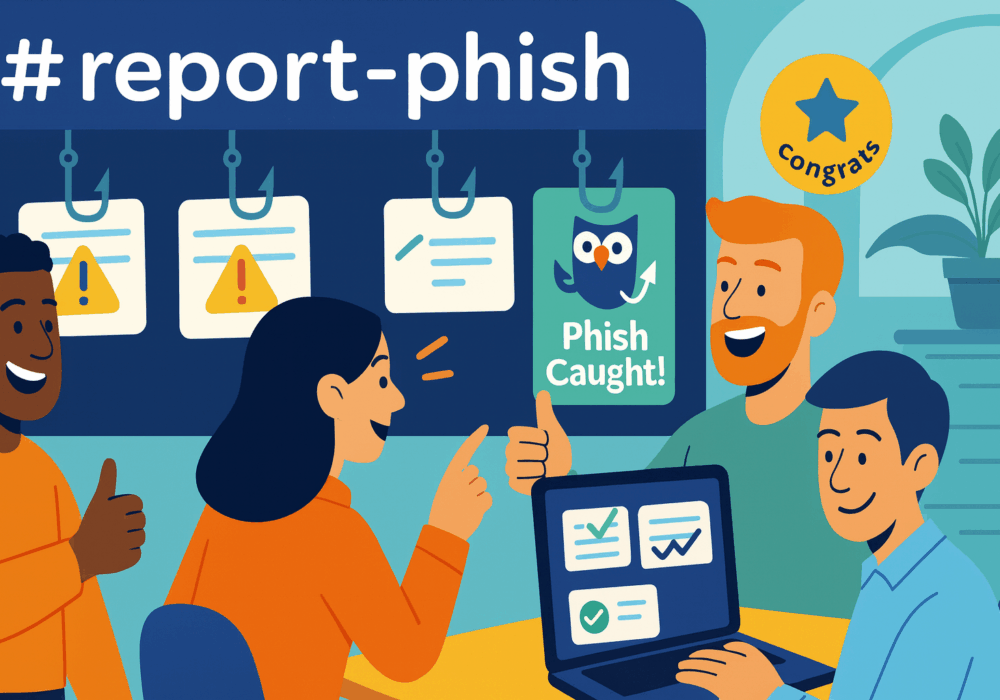
CyberHoot believes security awareness should feel positive, empowering, and rewarding. Traditional phishing reporting methods often do the opposite. A “Report Phish” button to often sends emails into an IT black hole, leaving employees wondering if they did the right thing, and rarely hearing back immediately. It’s far better to provide an outlet for employees to help each other with a “Report Phishing Channel” in Slack or Teams (any instant messaging channel) for staff to participate in and help each out out.
A lack of immediate feedback stifles employee learning. Over time, employees will become much less engaged and far less likely to report phishing emails.
Why Traditional Reporting Falls Short
However, it doesn’t have to be that way.
A Better Way: Positive, Real-Time Phishing Email Reporting
Instead of siloed reports, imagine a shared “Report Phishing Channel” in Slack or Teams dedicated to spotting and reporting phishing. This simple shift turns reporting into a collaborative, rewarding learning opportunity. This approach removes the burden of IT from all but the “contested reports” where an expert must weigh in. It allows, colleagues and phishing aware employees, to help confirm and point out the telltale signs that a potential Phishing email IS a phishing email.
Such channels will often begin seeing SMS or Smishing examples, voice based social engineering comments, and sometimes even Quishing (QR Code) phishing examples. This channel will fill with all manner of social engineering attempts on your company, and that’s a powerful piece of cybersecurity resilience.
This philosophy powers CyberHoot’s HootPhish platform: positive reinforcement, shared learning, gamification, and zero shaming. A collaborative report phishing channel follows these same principles.
This approach turns phishing defense from a compliance checkbox into a cultural superpower. Employees no longer dodge mistakes themselves. Instead they learn, teach, aid, and strengthen each other.
This is the best way to secure more engagement with fewer facepalms and more high-fives!
Discover and share the latest cybersecurity trends, tips and best practices – alongside new threats to watch out for.

Phishing emails used to be easy to spot. Bad grammar. Weird links. Obvious scams. Those days are...
Read more
Cybercriminals always follow Internet eyeballs. Not literally, but figuratively. And today's eyeballs are...
Read more
Active Attacks on Messaging Apps The Cybersecurity and Infrastructure Security Agency (CISA) recently issued...
Read moreGet sharper eyes on human risks, with the positive approach that beats traditional phish testing.