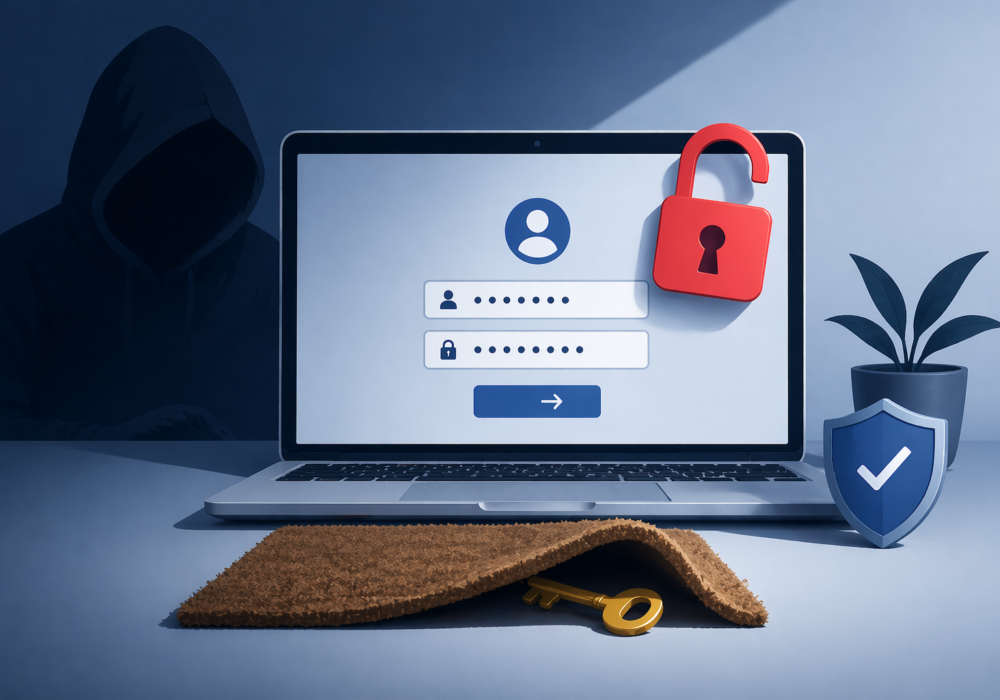
Most breaches don’t start with a hacker in a hoodie cracking code at 3am. They start with your username and a password from a breach that happened three years ago at a site you forgot you signed up for.
Picture a thief who skips picking the lock entirely because the key is sitting right there under the mat. That’s what most cyberattacks look like in 2026. Attackers aren’t writing exotic code to break into your systems. They’re logging in with credentials your employees already use, often credentials stolen from a completely different website years ago and sold for a few dollars online.
This matters for your organization because the attack doesn’t set off alarms the way a break-in does. A successful login with a valid username and password looks exactly like an employee starting their day. No malware alert fires. No suspicious traffic gets flagged. The attacker blends in, and that’s what makes this so effective.
When an attacker gets hold of a valid username and password, the first thing your security tools see is a normal login. There’s no malware. No weird file download. No red flag. The attacker looks like an employee.
From there, the attacker starts exploring. They look for other accounts they can access with the same password or close variations of it. They try to get into email, cloud storage, accounting tools, or anything else your organization uses. Once they find a foothold with slightly more access, they use that to go further. For ransomware groups, this whole chain from first login to full lockdown takes hours. For quieter attackers, it takes weeks and you often don’t know they were ever there.
The basic attack hasn’t changed much. What has changed is the speed. Attackers now use AI tools to test stolen credentials across dozens of services at once, write phishing emails that read like they came from your CEO, and generate fake login pages that look identical to the real thing.
A phishing email used to be easy to spot: bad grammar, weird sender address, urgent tone. Today’s AI crafted messages are more appealing and more devious in their delivery, but still contain tell-tale signs they are fake and untrustworthy. They are simply more appealing today having consumed your online persona to draft multiple emails that appeal to your sense of self, or your passions in life. As a result, it’s so important for your team build good cyber habits so they trust their instincts when something feels off.
The good news is that the defenses haven’t changed much either. Multi-factor authentication, unique passwords stored in a password manager, and knowing how to recognize suspicious emails are still the most effective tools you have. They work against AI-assisted attacks the same way they worked against older, less polished attacks. Remember also to foster a cybersecurity culture where people are encouraged, if not rewarded, for reporting potential security issues without recrimination.
If a breach does happen, the way your team responds matters as much as the tools you have. Most people expect incident response to be a straight line: find the problem, contain it, clean it up, move on. Real incidents almost never work that way. When an employee reports something off about their email or computer, time to respond is a critical factor to containment and limiting collateral damage.
As your team investigates, they’ll find new information that changes what they thought they knew. A single compromised account turns into three. A malware scan reveals a backdoor that was installed two weeks ago. The scope grows as you look closer, and a good response process accounts for that. The Dynamic Approach to Incident Response, or DAIR, is one framework that treats this as normal. Your team scopes the problem, contains what they can, cleans up what they find, and then loops back to check if there’s more. Each pass teaches you something new.
Communication is what separates a contained incident from a chaotic one. When your IT lead, office manager, and leadership team all have different information, decisions get made, actions are taken, based upon bad or missing information.
Start by documenting your Incident Response Plan. At CyberHoot, our vCISO’s call this our Cyber Incident Management Plan (or CIMP). In this plan we write down who is responsible for what, who they notify, and how they communicate during an active incident. A short contact list and a shared update channel remove the guesswork when things get stressful.
Once the plan is written, practice it. Annual tabletop exercises walk your team through realistic mock scenarios, step by step, without any real damage. Your team talks through what they would do, who they would call, and what they would say. Those key contact numbers are validated and made current. That kind of practice builds accuracy and real confidence in your Incident Response team.
After each tabletop exercise it’s equally important to review what worked, update the plan, and assign any follow-up actions. An Incident Response plan that never gets tested is just a document. A plan your team has practiced is a real line of defense.
Protecting your organization from credential-based attacks takes some smart preparations. First, turn on multi-factor authentication for email, cloud tools, and any remote access your team uses. Audit it too, and make sure there are no exceptions. MFA stops most credential attacks before they go anywhere.
Next, adopt a password manager and train your staff on using it. A password manager helps users create unique passwords for every account, improves efficiency, and even blocks some credential-stealing phishing attacks when a user accidentally clicks on a fake vendor link.
Finally, share your war stories, close calls, and real examples of attacks with your team. Train them on what suspicious emails look like, what fake login requests look like, and who to report this to when something seems off.
These three steps close more doors than most expensive security tools. You don’t have to be perfect. You have to be harder to break into than the next organization on the list.
Every good habit your team builds today is one fewer opening for an attacker tomorrow. That’s worth celebrating. Hoot up!
नवीनतम साइबर सुरक्षा रुझानों, सुझावों और सर्वोत्तम प्रथाओं के बारे में जानें और उन्हें साझा करें - साथ ही नए खतरों के बारे में भी जानें।
अधिकांश सुरक्षा उल्लंघनों की शुरुआत किसी हुडी पहने हैकर द्वारा रात के 3 बजे कोड क्रैक करने से नहीं होती। इनकी शुरुआत आपके यूज़रनेम और... से होती है।
अधिक पढ़ें
vCISOs के लिए एक व्यावहारिक संक्षिप्त विवरण: वह चेतावनी जिसे हमने अनदेखा किया या समझ नहीं पाए। वर्षों से, सबसे विश्वसनीय...
अधिक पढ़ें
फर्जी सीईओ को असली रकम मिलने से पहले ही वरिष्ठ कार्यकारी अधिकारी बनकर धोखाधड़ी करने वालों को पहचानने के लिए एक गाइड। यह...
अधिक पढ़ेंपारंपरिक फिश परीक्षण को मात देने वाले सकारात्मक दृष्टिकोण के साथ मानवीय जोखिमों पर अधिक पैनी नजर रखें।